


- Date of Birth:
- 1866
- Date of Death:
- 1913
- Place of Death:
- Dunkeld
- Residence in Dumfries & Galloway:
Stayed at Lochinvar Hotel, Dalry, 1895
His centenary exhibition contained Galloway works painted or exhibited in 1895, 1900, 1907, 1908, 1910, 1911 and 1913
- Education:
Slade School
- Professional Bodies:
RI 1906; RSW 1913
- Exhibited At:
Between 1887 and 1913 exhibited in all but two years at the Royal Academy
- Associates:
Norman Wilkinson
- Notes:
Ernest Briggs was born in Broughty Ferry, the youngest of five children of Henry Currer Briggs and Catherine Shepherd. The Briggs family were colliery owners in Yorkshire, but Ernest’s father also become involved in the jute industry in Dundee, where, in the 1860s, he was a partner in the firm of Thomson, Shepherd and Co.
Owing to poor health Ernest was unable to join his brothers in the coal industry but the family’s wealth allowed him to pursue his interest in art.
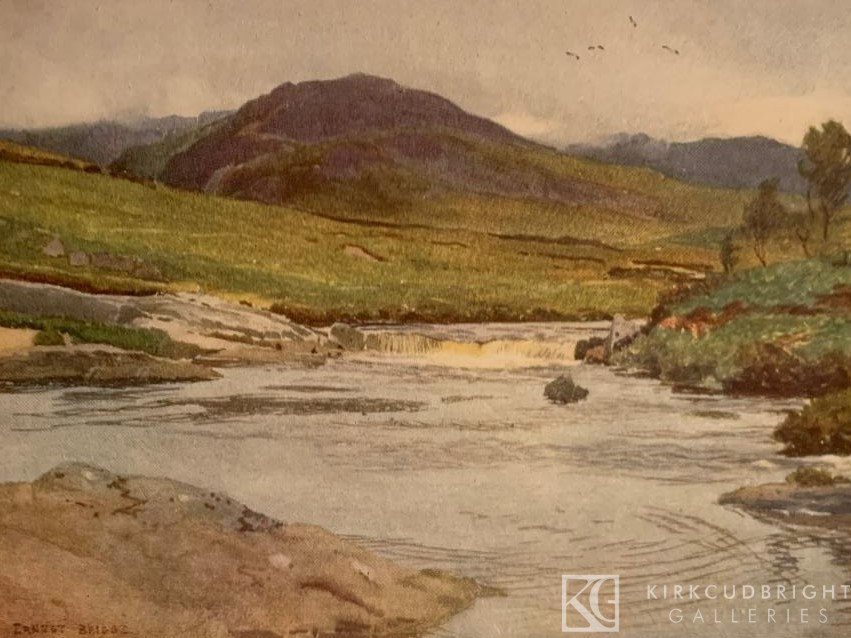
Author and illustrator of Angling and Art in Scotland (1912) Briggs excelled at painting moving water. In the book, he tells us that “it was at the age of thirteen, when we boys were given leave of absence for three weeks, to be spent in a fishing expedition in the enchanted lands of Galloway, that I became entirely imbued with the delights of angling.” The book contains several Galloway illustrations including Trout Fishing in Galloway, which was shown at the Royal Academy in 1903. In December 1908 there was an exhibition at the Fine Art Society, London, entitled Fishermen’s Haunts in Galloway and the Highlands. The exhibition contained over 20 Galloway views, many of them of the River Ken about Earlston Linn and other spots near Dalry.
A legacy in 1909 allowed Ernest to build a home in Scotland, Dalbeathie House near Dunkeld, where he died in 1913.
A centenary memorial exhibition was held at the galleries of the Federation of British Artists in 1966. Among the exhibits were 11 works with Galloway titles including The Ken in Flood, which was lent by the Trustees of the Tate Gallery. The work, which had been shown at the Royal Academy in 1913, was purchased for the nation through the Chantrey Bequest.
Ernest Briggs was the father of the celebrated folklorist Katharine Mary Briggs.
