






- Date of Birth:
- 1860
- Date of Death:
- 1922
- Place of Death:
- Edinburgh
- Residence in Dumfries & Galloway:
Visited Galloway in World War I. New Abbey; New Galloway, 1920; Gatehouse of Fleet, 1921.
- Education:
Glasgow School of Art
- Professional Bodies:
NEAC, 1887; RP,1897; ARSA, 1889; RSA, 1905; RSW, 1885, President RSW 1915
- Exhibited At:
Royal Academy; Royal Scottish Academy; Royal Scottish Society of Painters in Watercolours; Royal Glasgow Institute of Fine Arts; Aberdeen Artists’ Society
- Associates:
With Crawhall and Guthrie, the first members of the Glasgow School; friend and neighbour of Whistler in London
- Bibliography:
Bourne Fine Art, E A Walton (exhibition catalogue, Edinburgh, 1981). Edward Arthur Walton, Fiona MacSporran, Glasgow, 1987. Kirkcudbright: one hundred years of an artists’ colony, Patrick Bourne, Atelier Books, Edinburgh, 2000. A History of Scottish art, Bill Smith and Selina Skipwith, Merrell, London, 2003. Five centuries of Scottish painting, Atelier Books, Edinburgh, 2006
SCRAN, Pathfinder pack
Image. Photograph of the artist by T and R Annan, Glasgow. For more information visit the web site www.annangallery.co.uk
- Notes:
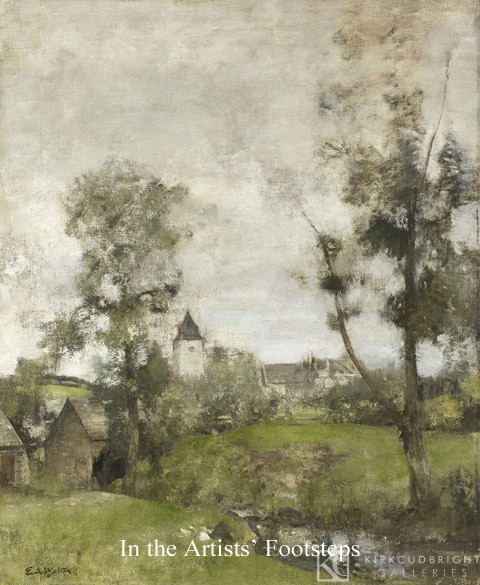
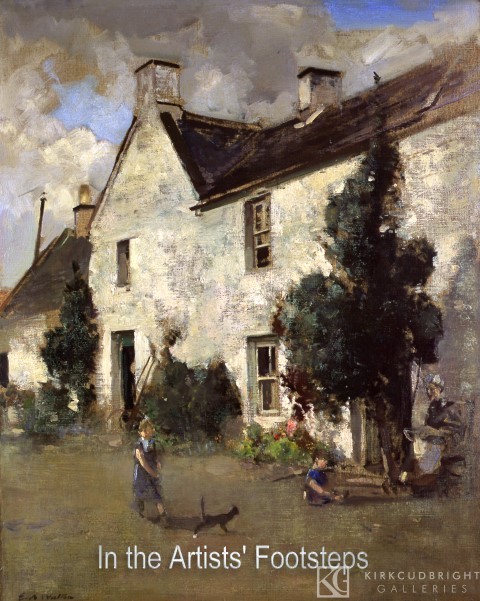
Friend and neighbour of Whistler in London. The Waltons and Newberys spent summer holidays in Suffolk. President of RSW, 1915. “Walton, like Guthrie, was much in demand as a portrait painter but he was a landscape painter by inclination.” Smith and Skipwith p105 (see bibliography). His A Gate by a farm, Galloway is illustrated in Bourne p8 (see bibliography). The Bourne Fine Art exhibition (see bibliography) included A River in Galloway, The River Dee, Galloway, The Clock Tower, also known as A Dull day and another of The Clock Tower. The latter works were of the clock tower at Gatehouse of Fleet.
A leading member of the Glasgow Boys, who painted in both England and Scotland, E A Walton came to know Galloway towards the end of his life. Whereas Guthrie, Henry and Hornel are associated with Kirkcudbright on Hornel’s return to Scotland in 1885, Walton did not come to Galloway till the World War 1.
Edward Arthur Walton was born in Renfrew near Glasgow in 1860. He spent some time at the Dusseldorf Academy before entering Glasgow School of Art in 1878. It was here that he became friendly with Guthrie and Crawhall, and painted with them and others at Roseneath on the Clyde, Brig o’Turk in the Trossachs, and Cockburnspath in Berwickshire and in Lincolnshire and Surrey. His skill as a painter of watercolours earned him membership of the Royal Scottish Society of Painters in Water Colours in 1885 and shortly after he became a member of the New English Art Club.
From 1894 to 1904 Walton lived in London, first in Kensington but then in Cheyne Walk, Chelsea where he was a friend and neighbour of Whistler. It was said that he was the only one of his acquaintances with whom the irascible Whistler never quarrelled. Here his neighbours also included Philip Wilson Steer and John Lavery. In the summer the Walton family went to Suffolk where they rented the Old Vicarage at Wenhaston, not far from Walberswick, where F Newbery and his family painted in the summer. Walton’s daughter, Cecile and Newbery’s daughter Mary, became close friends and later both developed strong links with Galloway. It was in Suffolk that Walton painted his celebrated portrait of a local gamekeeper’s daughter, The Briony Wreath.
In 1904 Walton returned to Scotland and settled in Edinburgh, the same year that he became a Member of the Royal Scottish Academy. Although based in Edinburgh Walton travelled regularly in the UK and abroad. In 1914 he became President of the Royal Scottish Society of Painters in Watercolour, but war soon restricted his travel and it was then that he discovered Galloway, painting first about New Abbey and latterly at New Galloway and finally at Gatehouse of Fleet.
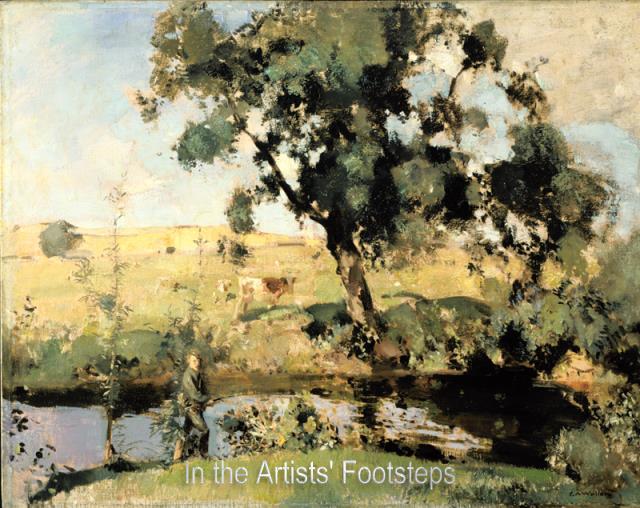
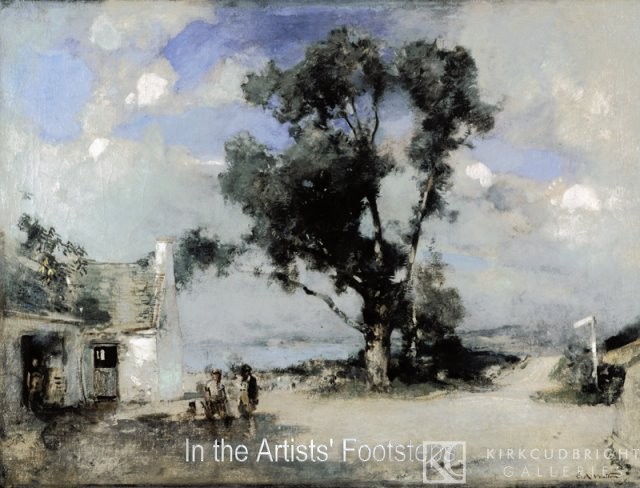
First and foremost a landscape painter, the atmosphere of a place was as important to Walton as the precise location. That is certainly the case with fine works such as The Gates of Galloway or The Smiddy at the Cross Roads, said to have been painted near Gatehouse. Figures and animals often feature in Walton’s landscapes. There is a timeless quality as the horsemen pause to gaze on the ancient ruins in his Sweetheart Abbey or in The Amber Pool, where the fisherman turns quietly towards the artist.
In 1921 E A Walton spent the summer in Anne Street, Gatehouse and was joined by his daughter Cecile and her husband Eric Robertson. Here he painted his last pictures, for he died the following spring.
